Understanding Spanish Vehicle Registration Documents
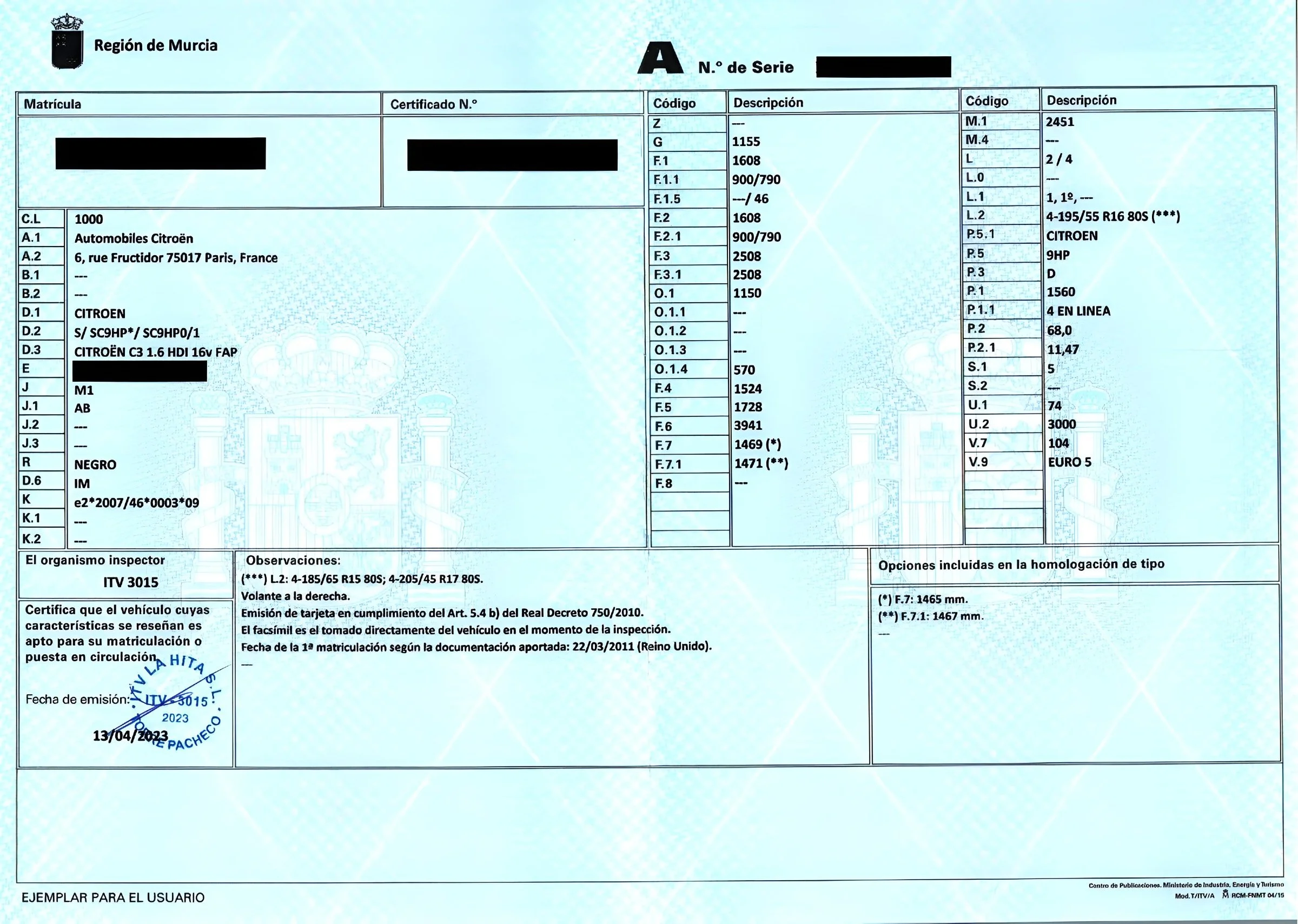
If you own a Spanish vehicle, you may already have noticed that the Spanish registration documentation contains more information than many equivalent documents from other European countries. However, not every section is immediately obvious at first glance.
Below is a practical guide to many of the most common letter codes that appear on a standard passenger vehicle Ficha Técnica, helping you understand what the various sections refer to and why they matter.
🚘 Vehicle Info
- CL – Vehicle classification
🏭 Manufacturer Info
- A.1 – Name of vehicle manufacturer
- A.2 – Address of vehicle manufacturer
- B.1 – Completed vehicle manufacturer’s name
- B.2 – Completed vehicle manufacturer’s address
🚗 Model Variant
- D.1 – Brand
- D.2 – Type / Variant / Version
- D.3 – Commercial name of vehicle
- D.6 – Origin, if imported etc.
📏 Weights & Measurements
- F.1 – Maximum permitted technical laden mass
- F.1.1 – Maximum permitted mass on each axle, separated by “/”
- F.1.5 – Maximum permitted mass on the 5th wheel or coupling device, if applicable
- F.2 – Maximum permissible laden mass
- F.2.1 – Maximum permitted mass on each axle, separated by “/”
- F.3 – Maximum technically permitted mass of the assembly
- F.3.1 – Maximum permitted mass of the assembly
- F.4 – Vehicle height
- F.5 – Vehicle width
- F.6 – Vehicle length
- F.7 – Track of front axle
- F.7.1 – Track of rear axle
- F.8 – Rear overhang
- G – Mass of vehicle
📄 Homologation
- J – Category of vehicle
- K – European type approval
- K.1 – Completed vehicle homologation number
- K.2 – ITV certificate number of the base vehicle
🛞 Axles, Wheels & Tyres
- L – Number of axles and wheels
- L.0 – Number and position of axles with twin wheels
- L.1 – Number and position of drive axles
- L.2 – Tyre dimensions with load and speed rating
- M.1 – Distance between axles
- M.4 – Distance between the 5th wheel or coupling
🚙 Towing & Trailers
- O.1 – Towable mass with brakes
- O.1.1 – Drawbar
- O.1.2 – Half-trailer
- O.1.3 – Centre axle trailer
- O.1.4 – Trailer without brakes
🚘 Engine
- P.1 – Engine size (cc)
- P.1.1 – Number of cylinders and layout
- P.2 – Engine power (kW)
- P.2.1 – Fiscal horsepower (CVF)
- P.3 – Fuel type
- P.5 – Engine identification code
- P.5.1 – Engine manufacturer (or brand)
💺 Seating
- S.1 – Number of seats
- S.2 – Number of standing spaces
🔊 Noise
- U.1 – Noise level when stationary
- U.2 – Engine speed at which the noise level is measured
🌐 Emissions
- V.7 – CO2 emissions
- V.9 – Euro status
📄 Other Items
- R – Colour
- Z – Year and serial number of short series
A Practical Guide to the Main Codes
While this list is by no means exhaustive, it covers many of the main codes that you are likely to come across on a typical Ficha Técnica for a passenger vehicle.
The Ficha Técnica also serves as an ITV card, and newer versions now include a guide to the codes in Spanish as well.
We Can Help You Check the Details
If you are unsure about any information shown on your Spanish registration documents, our team can help you understand what it means and how it affects your vehicle.