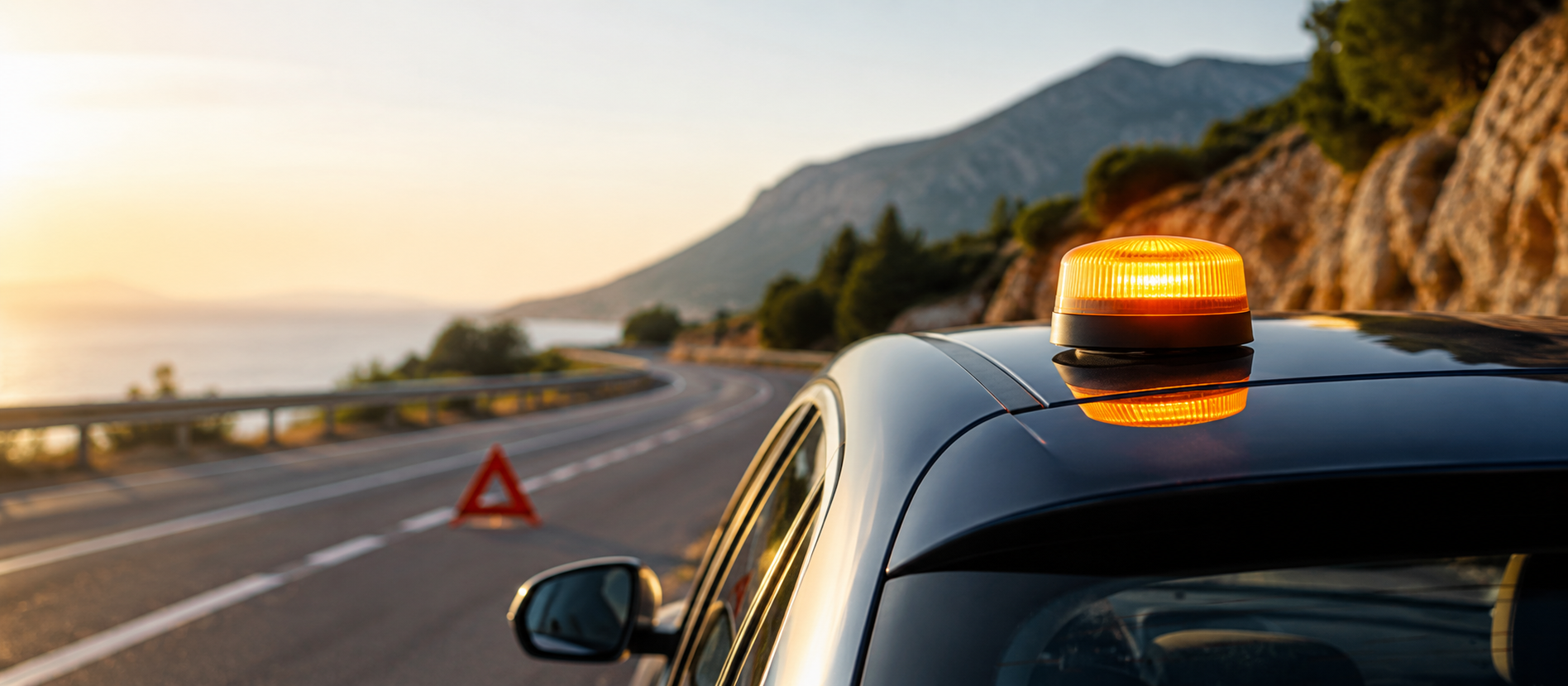
Is Your V-16 Beacon Legal in Spain?
What drivers need to know about connected V-16 beacons, warning triangles and Spain’s 2026 roadside safety rules.
Confused About Spain’s New V-16 Beacon Rules?
If you drive in Spain, you have probably seen lots of conflicting information about V-16 emergency beacons, warning triangles and the new rules that came into force from 1 January 2026.
At Car Registrations Spain, we help foreign vehicle owners every day, so we have created this simple guide to clarify what expats and foreign vehicle drivers actually need to know.
What Changed from 1 January 2026?
From 1 January 2026, Spanish-registered vehicles must use a connected V-16 beacon as the legal emergency warning device.
The V-16 is designed to reduce the need for drivers to walk along the carriageway to place warning triangles after a breakdown or accident.
Old V-16 Beacons May Not Count
A simple flashing orange V-16 light is not enough. The device must be a certified connected model capable of communicating with the DGT 3.0 platform.
Many drivers bought early V-16 lights before connected models were widely available, so it is important to check exactly what you have.
A Flashing Orange Light is Not Automatically Legal
This is the biggest misunderstanding. Some older V-16 lights may still flash perfectly, but they will not meet the legal requirement from 2026 if they are not connected and certified.
Before relying on a beacon in Spain, you should check four key points:
Connected
The device must be able to transmit the location of the incident when it is activated.
Certified
The exact make and model should appear on the official DGT certified device list.
No App Needed
A valid connected V-16 should not depend on your mobile phone or an app to transmit its location.
Check the Date
Look for the expiry or connectivity date shown on the device or packaging.
If your V-16 beacon is not a connected, certified model, it may not be valid as the legal warning device from 1 January 2026.
Is Your V-16 Beacon Actually Legal?
Before buying or relying on a V-16 beacon in Spain, check that it is not simply a flashing emergency light. A legal connected V-16 device should meet the following points:
Do Foreign-Registered Vehicles Need One?
Foreign-registered vehicles in international circulation may still use warning triangles, but carrying a valid connected V-16 beacon can help avoid confusion during a roadside incident.
If you live in Spain, or your vehicle should already be registered onto Spanish plates, you should be especially careful about relying on the foreign vehicle exception.
Does the Beacon Call Emergency Services?
No. The V-16 beacon is not a replacement for calling emergency services, your insurer or roadside assistance.
The connected beacon is designed to warn other road users and transmit the incident location to the traffic platform when activated.
Should You Still Carry Warning Triangles?
Although the connected V-16 beacon becomes the legal warning device for Spanish-registered vehicles, we still recommend carrying traditional warning triangles as an additional safety measure.
The important point is that triangles should only ever be used if it is absolutely safe to place them. You should never walk along the carriageway, cross live traffic, or put yourself at risk simply to position a triangle.
Use the V-16 First
The V-16 beacon can normally be activated and placed on the vehicle quickly, reducing the need to walk into a dangerous area.
Use Triangles Only if Safe
Triangles can provide extra advance warning, but only place them if you can do so without putting yourself or others in danger.
Do Not Walk in Live Traffic
The main reason Spain introduced the V-16 system was to reduce the risk of drivers being hit while leaving the vehicle to place or remove warning triangles.
Safety Comes First
If visibility is poor, traffic is heavy, the road is narrow, or you are on a motorway or fast road, it may be safer not to place triangles at all.
Our practical advice is simple: carry a connected V-16 beacon and keep your warning triangles, but only use the triangles as an additional warning when it is genuinely safe to do so.
Common V-16 Misunderstandings
These are some of the most common questions and misunderstandings we see from English-speaking drivers in Spain.
“I already bought a V-16, so I’m covered.”
Not necessarily. If it is not a connected, certified model, it may not be valid from 1 January 2026.
“I need to register it to my car.”
A valid connected beacon should not need to be registered to a specific vehicle or number plate.
“The beacon tracks me all the time.”
The device is intended to transmit the location of the immobilised vehicle when activated, not to track normal journeys.
“One beacon is enough for the family.”
The device must be available in the vehicle you are using. You can move one between vehicles, but it is easy to forget.
What About Motorcycles?
For motorcycles, the DGT recommends the use of a V-16 beacon because of the safety benefits, but it is not mandatory in exactly the same way as it is for cars and other vehicles.
Even where it is not compulsory, carrying one may still be a sensible safety precaution.
What About Reflective Vests?
The V-16 beacon does not replace the need to act safely at the roadside.
You must still use hazard lights, wear high-visibility clothing where required, and move away from danger where possible.
What Should You Do in a Breakdown or Accident?
Every roadside incident is different, especially on motorways, bends, hard shoulders and poorly lit roads. Your safety should always come first.
Stay Visible
Use your hazard lights and assess whether it is safe to leave the vehicle.
Activate the V-16
Switch on the beacon and place it as high as possible without putting yourself in danger.
Move to Safety
If safe, leave from the side away from traffic and move behind a barrier or protected area.
Call for Help
The beacon is not a replacement for emergency services, your insurer or roadside assistance.
Frequently Asked Questions
Can I still use warning triangles in Spain?
For Spanish-registered vehicles, the connected V-16 replaces warning triangles as the required warning device from 1 January 2026. However, triangles may still be used as an additional warning where it is safe to do so. Our recommendation is to carry them, but only place them if you can do so without putting yourself at risk.
Does the V-16 track me all the time?
No. The connected V-16 is intended to transmit the location of the immobilised vehicle when the device is activated. It is not intended to track your normal journeys.
Do I need a mobile phone signal?
A valid connected V-16 contains its own communication equipment. You should not need to pair it with your phone or install an app for the DGT location function.
What if I bought my beacon cheaply online?
Check it carefully. Some low-cost devices are simple flashing lights and may not be certified connected V-16 devices. The key test is whether the exact model appears on the official DGT certified list.
Can I use a Spanish V-16 beacon outside Spain?
The DGT indicates that Spanish-registered vehicles may use the connected V-16 when travelling abroad in countries covered by the relevant international conventions. However, if you regularly travel across borders, it is sensible to check the local requirements of the country you are visiting.
Official source:
DGT V-16 beacon information and certified device list
.
The V-16 Rules Are Only One Part of Staying Legal
If your vehicle is in Spain long term, you may also need to consider Spanish registration, ITV requirements, import tax, insurance and the legal use of foreign plates.